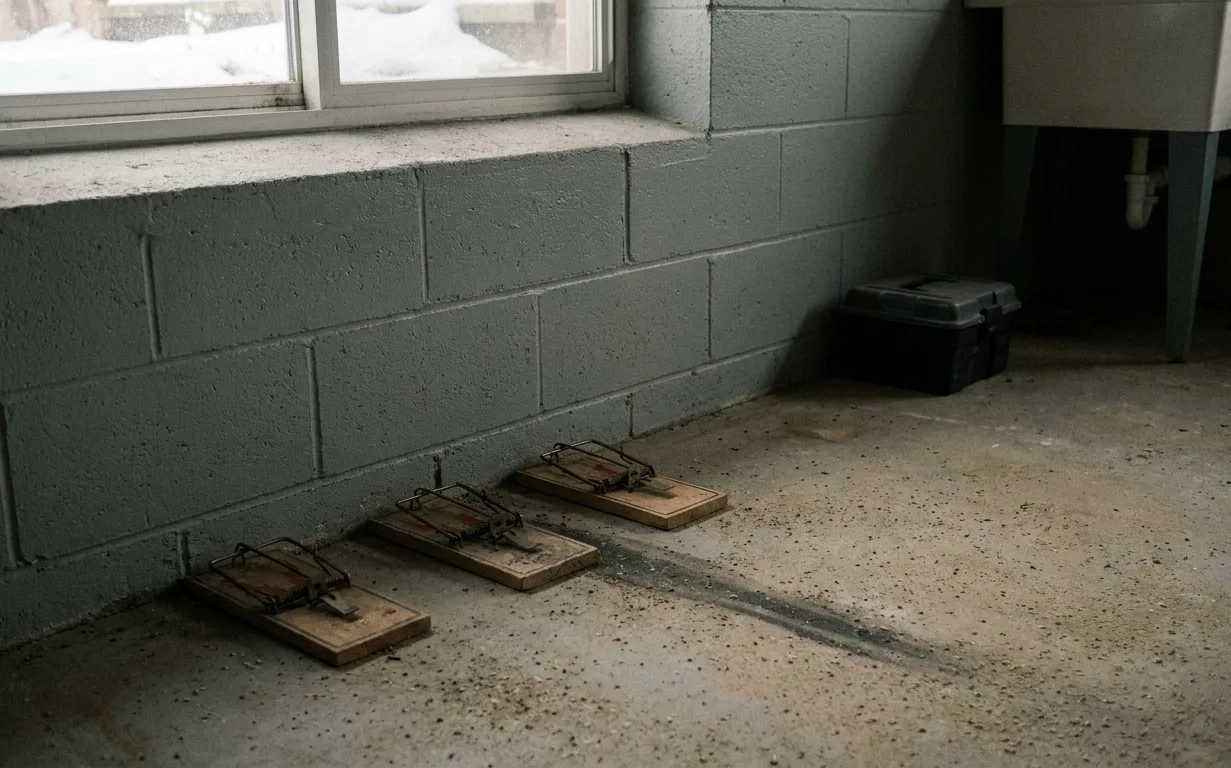
Why we trap instead of baiting indoors
Rodenticide in a house has one serious drawback: nobody picks where the animal dies. A mouse that eats bait in the basement goes back into the wall, under the floor or into the attic insulation, and you locate it later by smell. A trap holds the catch where we can pick it up and count it.
At Grand Rapids Rodent Control we keep loose bait out of houses entirely. Outdoors, bait has a role in some rat jobs, always inside locked stations and only after we have talked through kids, pets and the neighbors' animals with you.
Counting is the point. A trapline that takes six mice the first week, two the second and none the third is telling us the work is done. Bait gives no signal like that. With poison you are left guessing whether the quiet means success or just a lull before the next wave, and guessing is a poor way to end a job.
The traps we rely on
- Snap traps sized for mice or for rats. Simple, fast and still the most dependable tool in the truck.
- Covered stations that hold the traps, so a curious dog or a toddler cannot get near the trigger.
- Multiple-catch mouse traps for garages and storage rooms where mice travel in numbers.
- A thin dusting of flour or talc on a basement floor to show footprints overnight before we commit traps to a spot.
Traps belong on runways
Mice and rats do not cross the middle of a room if they can help it. They run along walls, behind appliances, along the top of foundation walls and across pipes, keeping their whiskers against a surface. A trap in the open catches very little. A trap tight to the wall on a runway, with the trigger facing the wall, catches what comes through.
Reading runways is the real skill. We go by rub marks, droppings and gnawing, and in dusty basements by tracks. A trap moved two feet to the right is sometimes the whole difference.
We also think about what else uses the space. A basement with a cat door, a garage where kids grab bikes, a laundry room where someone kneels to load the dryer: traps get placed and boxed so the household can carry on normally while the trapline works.
How a trapping schedule runs
Set
Each runway we marked while inspecting gets its traps before we pack up and leave.
Check
We return within a few days, remove catches, note where each one came from and move any trap that sat quiet.
Narrow
Each visit, the trapline tightens around the areas still showing activity.
Seal
Once catches drop off, we close the entry points so nothing new arrives. That work is covered on the rodent exclusion page.
Confirm
A check with no new catches and no fresh droppings is our cue to pull the traps.
Winter timing in West Michigan
October and November are the busy months. Mice have just come inside, they are exploring, and they walk into traps readily. Late winter is different. The ones left are settled, they know every inch of the house, and they can be more cautious around anything new. Trapping still works then, it just takes more checks.
Deer mice brought in with stored gear from a cottage or camper add another wrinkle. They often show up in spring when boxes get unpacked, well after the usual season, and they tend to stay close to wherever that gear was put away. Traps go there first, and cleanup of their droppings follows the careful wet method rather than a broom.
Outdoor rat trapping is easier with snow on the ground, since tracks show the runs plainly and burrows near a garage stand out. If your trouble is rats around a detached garage, our rat control page explains the outside work.
Trapping without sealing is a treadmill. We tell everyone that, because we have seen the same house trapped every fall for years with the same hole by the gas meter.
Removing what we catch
We take every catch away, bagged and handled with gloves. If a rodent died inside a wall before we arrived, we track it by smell and flies and get to it where the access allows. Sometimes that means cutting a small opening in drywall and patching it, and we ask before we do.
Where catches came from matters as much as how many there were. We keep a simple record of each trap location and what it took, and that pattern usually points straight at the entry. Five mice caught along the back basement wall and none anywhere else is a strong hint about where the sealing needs to focus.
Garages, basements and kitchens each get handled differently
Garages
Garages are cold, open and full of stored food like grass seed and birdseed. We use more traps here, often multiple-catch units along the walls and beside the door track, and we look hard at the bottom seal and the corners of the overhead door.
Basements
In an older basement, the runways are usually along the top of the foundation wall, the sill, and the pipes and ducts that run across the ceiling. Traps sometimes go up on those ledges, not just on the floor.
Kitchens
In living space, every trap goes inside a closed station and out of sight: under the sink, behind the stove kick plate, at the back of a lower cabinet. Nobody should be stepping over a trap to make coffee.
The rest of the picture, including where the trapping fits in a full job, is on our mice exterminator page for houses and on our commercial rodent control page for businesses. Older homes with stone basements in Garfield Park are a frequent setting for the basement-ledge approach.
Trapping questions
Can I check the traps myself between visits?
You can, and some people prefer to. We show you how to empty and reset them, and you can call with what you find. Wear gloves and never handle a catch bare-handed.
Why aren't the traps catching anything?
Usually they are off the runway, or the mice have easier food nearby. Sometimes it means the problem is already over. The check visits sort out which.
Do traps work on rats?
Yes, with the right size and setup. Rats are wary of new objects, so we sometimes leave rat traps baited but unset for a few days first.
What do you bait the traps with?
Whatever they have been eating. Peanut butter works on a lot of mice, cotton or nesting material works in the cold months, and rats go for nuts or dried fruit.
How soon after trapping starts will the noise stop?
Often within the first week or two, as the active mice get caught. Noise that continues after that usually means more are still getting in, which is why sealing follows right behind.