Why October is mouse season here
All summer, mice live outside in tall grass, garden beds, vacant lots and the edges of parks. When nights drop into the thirties, they go looking for warmth, and a house is a big warm box with food in it. By the time the first lake-effect snow comes off Lake Michigan, the mice that found a gap are already nesting for the winter.
A house mouse can get through an opening about the width of a pencil. Its skull is the only rigid part that has to fit, so if the head goes through, the rest follows. That is how a house that feels sealed to the people living in it can still have mice every year.
Signs mice have moved in
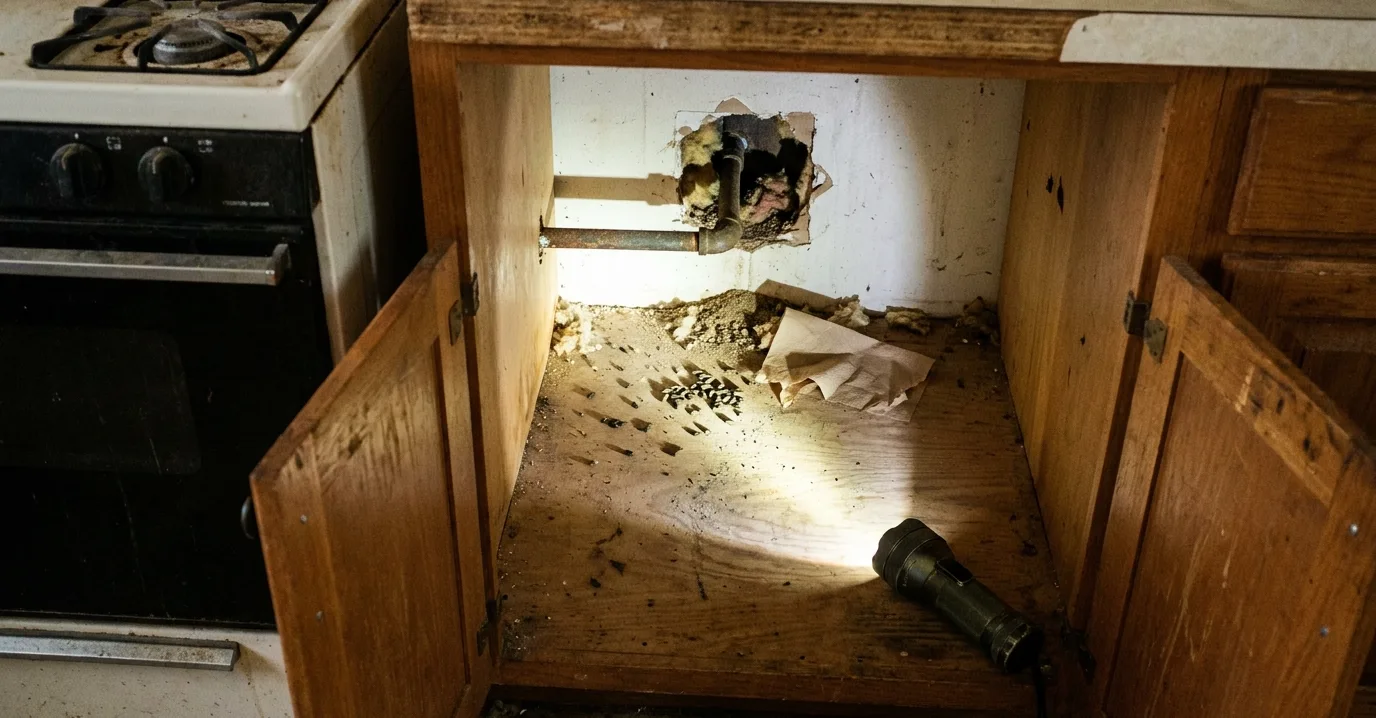
- Rice-sized droppings in kitchen drawers, under the sink, along baseboards or on top of the water heater.
- Scratching or rustling inside walls and ceilings after the house goes quiet at night.
- Chewed corners on cereal boxes, bags of flour, pet food and birdseed.
- Shredded paper towel, insulation or fabric balled up in a drawer, a box or the back of a cabinet.
- A faint, musty, ammonia smell in a closet or the basement that gets stronger as the weeks go on.
One mouse rarely means one mouse. If you have seen a single one run across the kitchen, it is fair to assume there are several more you have not seen.
Where they hide in older Grand Rapids houses
Balloon-framed walls
A lot of houses built before roughly the 1930s were framed with studs running in one piece from the foundation to the roof, with nothing blocking the cavity between floors. A mouse that slips in at the sill can climb inside that one cavity all the way to the attic. That is why you hear them in an upstairs wall even though they came in through the basement.
Attached garages
The shared wall between the garage and the house is often the weak point. Pet food and birdseed on the garage floor, an overhead door that does not meet the slab, and a crack where the garage slab butts the foundation all add up to an easy route.
Firewood, boxes and things from up north
Plenty of mice are carried in. They ride inside in armloads of firewood stacked against the house, in boxes brought home from a cottage, and in patio cushions stored over the winter. Deer mice and white-footed mice, the brown, white-bellied species from fields and woods, turn up most in stored cabin gear.
What we actually do on a mouse call
- Look for entry points from the foundation up, so we are not just catching whichever mice happen to be in the kitchen that week.
- Set snap traps in covered stations along walls, behind the range and under sinks, on the routes mice use.
- Come back on a schedule to empty, reset and move traps until the catches stop.
- Seal gaps with copper mesh, sealant and sheet metal, never with spray foam by itself.
- Point out storage changes that leave them less to come back for.
Trapping paired with sealing is how Grand Rapids Rodent Control approaches nearly every mouse job, because either one on its own tends to fail by the following fall. The trapping half is described in more detail on our trapping and removal page.
Why store-bought fixes tend to stall
Most people start with a few traps from the hardware store, catch two or three mice, and feel good for a week. Then the scratching returns. The traps were fine. The trouble is that new mice keep arriving through the same opening, and house mice can raise several litters over one winter indoors.
Loose poison pellets in the basement are a worse idea. The mouse eats them, crawls back into the wall and dies where nobody can reach it, and a week later the smell finds you. We do not put loose bait inside homes at all.
Plug-in ultrasonic devices are popular, and in our experience the mice get used to them quickly.
Houses where we see the most mice
Older homes in Heritage Hill and Garfield Park combine balloon framing, stone or block foundations and a century of patched holes, which makes them easy for mice. Newer houses are not exempt. A builder-grade home with an attached garage and a gap where the vinyl siding stops short of the foundation gets them too.
Duplexes and apartments share walls, so mice move from one unit to the next. When the source is in a space you do not control, we will say so plainly and tell you who needs to be involved.
Pantries, garages and cleaning up after them
Food storage changes more than people expect. Cereal, crackers, rice and baking supplies in thin cardboard are an open buffet. Move them into glass jars or hard plastic bins with snap lids for the colder half of the year. Wipe crumbs off the counter at night and keep the dog bowl empty after dinner.
In the garage, a 40-pound bag of birdseed or dog food sitting on the floor is the single most common thing we find chewed open. A galvanized can with a lid fixes that for good. Keep cardboard boxes up on shelves, not stacked against the wall, so you can see the base of the wall and so can we.
Firewood is worth a word on its own. Keep the pile away from the house and carry in only what you will burn that evening. A rack of split oak by the back door is a mouse condo with a view.
Mouse droppings run roughly a quarter inch long, dark, and tapered at both ends. Do not sweep or vacuum them dry. Spray them with a disinfectant or a bleach-and-water mix, let that soak for a few minutes, then wipe them up with paper towels while wearing gloves. That is the method the CDC lays out. If the mess covers an attic floor or a wide stretch of insulation, our attic rodent cleanup service is set up for that scale.
Mouse questions from Grand Rapids homeowners
How can I tell mice from rats?
Mouse droppings are rice-sized and pointed. Rat droppings are roughly twice as long and blunt. Mice also make light, quick scratching, often inside walls and ceilings, while rats tend to stay lower in a house.
Will the mice leave on their own in spring?
A few may wander back outside, but a mouse with a nest, food and water indoors has no reason to go. Most stay, and the young ones born inside have never lived anywhere else.
Can you set traps if we have a cat or dog?
Yes. Snap traps go inside covered or locked stations in spots pets cannot get to, and we ask about your animals before setting anything.
How many visits does a mouse job take?
Usually a first visit to inspect, trap and start sealing, then a few follow-ups to check traps and close anything that turns up. Houses with lots of openings need more.