Small gaps, big problem
Picture a pencil: a house mouse can squeeze through any hole it fits. A young rat fits through one about the size of a quarter coin. Older houses in Grand Rapids tend to have dozens of openings in that range, many tucked behind siding, under porches or along the top of the foundation where nobody looks.
Sealing is not running a bead of caulk around a window and calling it done. It is knowing which openings matter, which ones are actually being used, and what each one needs to stay closed through a Michigan winter.
It is also about priorities. Openings low on the house and near food get attention first, because that is where activity tends to concentrate. Higher gaps at the roofline matter too, especially on houses with trees or vines touching the siding, and they get handled once the ground-level work is done.
What we seal with, and why
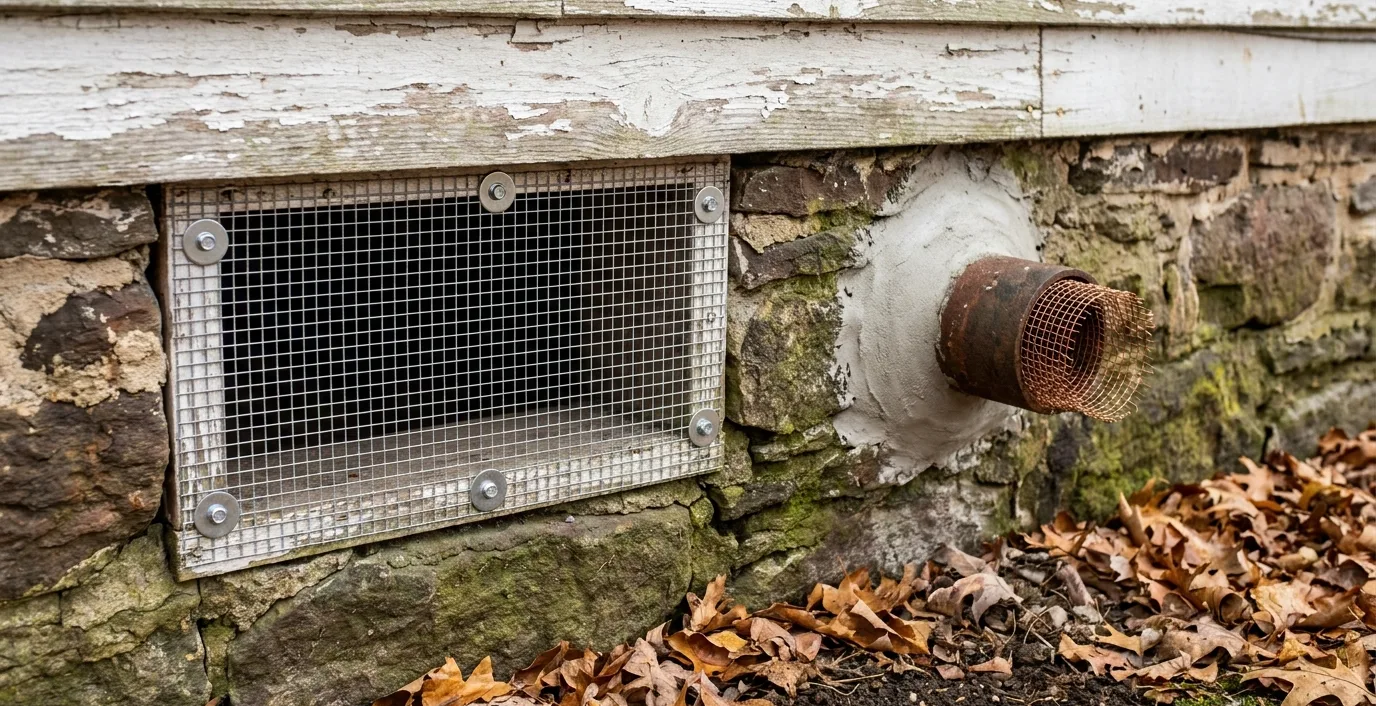
- Copper mesh packed into gaps around pipes and wires. It does not rust out like steel wool, so it holds for years instead of turning into an orange stain.
- Steel wool only as a quick temporary plug. It rusts in damp basements and mice pull it apart once it breaks down.
- Hardware cloth, a heavy galvanized wire mesh, over foundation vents, crawlspace openings, gable vents and the skirting under decks.
- Mortar and masonry patch for fieldstone and block walls where old joints have washed out.
- Sheet metal and door sweeps at garage door corners, under exterior doors and over chewed trim.
- Sealant on top of the mesh to finish it and stop drafts, never as the barrier itself. Spray foam alone gets chewed through in a night.
Every opening gets something teeth cannot get through, finished neatly enough that it keeps weather out and does not look like a patch job from the sidewalk.
Working on old houses without making them look worse
A lot of the houses we seal are older than anyone living in them, with wood clapboard, brick, original trim and stone that owners care about. We match the repair to the surface. Mortar for stone gets mixed and tooled to sit in the joint rather than smeared over the face. Sheet metal on trim gets cut to the profile and painted if you want it painted. Hardware cloth on a gable vent goes on the inside where possible, so the street view does not change.
Some fixes are not ours to make. A rotted sill that needs to be replaced, a porch pulling off the house, or a chimney that needs rebuilding calls for a carpenter or a mason. We tell you what we found, seal around it as well as we can for now, and leave the structural work to the right trade.
Frost heave, settling and gaps that come back
Ground here heaves with frost every winter and settles back every spring. Over the years that movement opens cracks along foundation walls, lifts concrete stoops and porches away from the house, and pulls garage slabs away from the wall they used to meet. A seam that was tight ten years ago can be a rodent door today.
That is also why we recheck sealing on follow-up visits, and why a house sealed once may need touching up later. Wood rots, mortar weathers, and somebody drills a new cable line through the rim joist.
Our job at Grand Rapids Rodent Control is to seal so it lasts as long as the materials allow and to say so honestly when something needs another look.
The openings we find most often
Sill plates and rim joists
In older houses the wood sill resting on the foundation is rarely flush. Gaps along the sill and at the rim joist where pipes and wires pass through are probably the most common way mice reach a basement.
Garage doors
The rubber seal on the bottom of an overhead door wears out, gets chewed, or never matched an uneven slab to begin with. Mice slip under at the corners. A new bottom seal and metal guards at the corners close it.
Fieldstone foundations
Old stone walls lose mortar from the outside in. We repoint the joints rodents are using, which often line up with the softest soil and the places burrowing rats have been digging.
Roofline and vents
Unscreened gable vents, gaps where soffit meets roof, and openings around chimneys let mice that climb siding into the attic.
Sealing comes after trapping
We never seal rodents in. If a house still has active mice or rats, we trap first and seal as activity drops. Closing everything too early leaves animals inside walls, where they chew new exits or die out of reach. The trapping side is on our rodent trapping page, and the full list of openings comes from a rodent inspection.
Houses in Belknap Lookout, with older frame homes packed onto the hill above downtown, are a good example of how many small openings one house can collect over a century of additions, porches and new wiring.
Small jobs you can handle yourself
Not every gap needs us. Plenty of homeowners are happy to take on the easy ones, and we are glad to point them out.
- Replace a worn door sweep on an exterior door so daylight no longer shows underneath.
- Keep shrubs trimmed back and mulch pulled a few inches away from the siding.
- Stack firewood away from the house and off the ground.
- Make sure the dryer vent flap swings shut on its own once the dryer stops.
- Shovel snow back from the foundation in winter so it does not build a ramp up to the siding.
Anything high, structural or inside a stone wall is better left to someone with the materials and the ladder for it.
Exclusion questions
Can I just use spray foam?
Foam is fine for air sealing, but mice and rats chew through it easily. If you use it, pack copper mesh into the gap first and foam over the mesh.
Will sealing block my vents?
No. Vents get covered with hardware cloth, which lets air move and keeps rodents out. We never seal combustion air intakes or dryer exhaust shut.
How long does exclusion work take?
A typical house takes a few hours to a full day. A fieldstone basement with a lot of mortar work can take longer, and roofline work may need a separate visit with taller ladders.
Do you seal garages as well as the house?
Yes. Garages are often where the trouble starts, so door seals, corner guards and the joint between the slab and the house wall are part of the job whenever they need it.
Does sealing keep rodents out for good?
It takes away the way in, which is as close to a lasting fix as there is. Houses keep shifting, though, so we recheck and patch anything new.