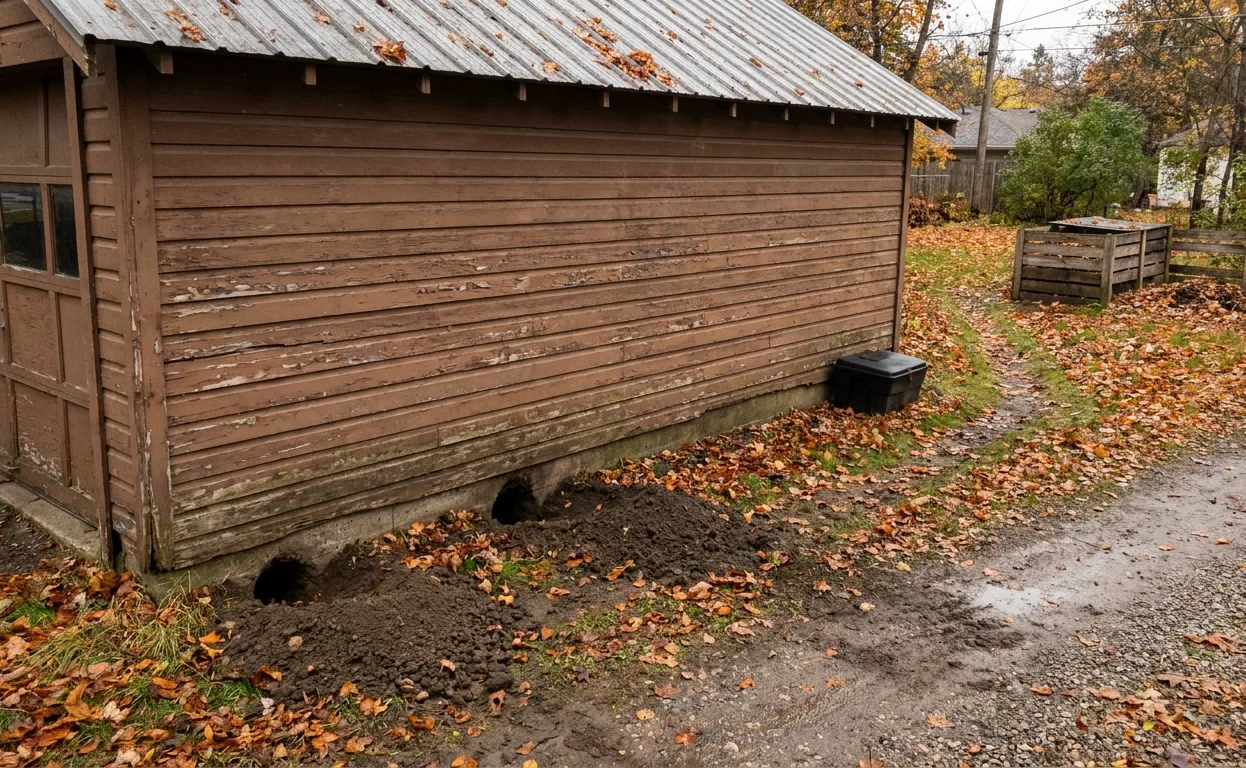
The rat you are dealing with is a Norway rat
Grand Rapids really has one rat worth talking about: the Norway rat, also called the brown rat or sewer rat. A grown one is stocky, close to a pound, with a blunt nose and a tail shorter than its body. It lives on the ground and under it, digging burrows in loose soil next to slabs, fence posts, foundation walls and woodpiles.
Because they prefer to stay low, most of what we find is at grade or below it. Basements, crawlspaces, the dirt under a deck, the fill beneath a detached garage. When someone hears light running overhead in a bedroom ceiling, that is usually mice. When a garbage cart in the alley has a hole chewed through the bottom corner, that is usually rats.
We only do rodents, and at Grand Rapids Rodent Control rat calls get handled with extra urgency, because rats breed quickly, chew through materials mice leave alone, and a colony that gets through one winter under a garage is almost always still there when the snow melts.
Clues that point to rats
- Droppings roughly half an inch to three-quarters of an inch long, thick and blunt, often piled in one spot near food.
- Holes two to four inches across in garden beds, under the lip of a slab or beneath a woodpile, usually with a spray of loose dirt fanned out in front.
- Dark, oily smears on concrete block or wood where bodies brush the same corner night after night.
- Chewed corners on garage service doors, plastic carts and the wooden frames around basement windows.
- A narrow worn path in the grass along a fence, like a footpath for something very small, running from cover to food.
Tiny, pointed droppings and scratching high up inside a wall suggest mice instead, and that calls for different tactics. Our mouse control page explains the difference.
The river, the 2013 flood and rats on the move
The Grand River runs straight through the middle of the city, and its banks, the rail corridors and the older industrial lots near it give Norway rats soft ground, cover and water. The north side, Creston included, has plenty of older lots with garages and alleys that rats like, and we take a lot of calls from blocks closer to the water.
High water moves them. When the Grand River reached a record crest in April 2013, low parks, lots and basements near the river flooded, and animals living in bank burrows had to go somewhere higher. Every heavy spring melt or week of rain does a smaller version of the same thing. If rats show up in a garage for the first time right after high water, that timing is rarely a coincidence.
How we run a rat job
Find where they live
We start outside with a light and a probe rod, looking for burrows, runways and the opening they use. Inside, we follow droppings and rub marks back toward that opening.
Remove the ones inside
Rat-sized snap traps go on the runways we found, usually inside boxes so dogs and kids cannot reach them. We check on a set schedule and take every catch away.
Work the burrows
Outdoor burrows get collapsed and watched for reopening. Where an outside station makes sense, it is locked, anchored and set along the route the rats travel.
Close the entry
When activity stops, the opening gets sealed with metal and mortar so the next rat has nothing to chew. See our exclusion and sealing page for materials.
Check again
We return to look for new dirt at old burrows and fresh marks on the runs before we call the job finished.
Garages, compost piles and bird feeders
Detached garages in older neighborhoods are rat magnets. The slab often sits on fill that tunnels easily, the rubber seal on the overhead door is torn or gone, and inside there is birdseed, dog food, grass seed and a recycling bin. A rat family can live under that slab and eat in that garage for months without ever going near the house.
In the yard, the usual draws are compost bins that take kitchen scraps, the spill zone under a feeder, fallen apples and dog waste left on the lawn. You do not need to quit composting or feeding birds. A closed bin with hardware cloth across the bottom and a tray under the feeder that gets emptied make a real difference. We point out what we see on each visit and leave the decisions to you.
Alleys count too. Where a row of carts lines the alley behind a block, a single cracked lid can feed rats for every house on it.
What helps between our visits
Rat work goes faster when the food dries up while the traps are out. Bring the birdseed and dog food into metal cans with tight lids. Put garbage out the morning of pickup instead of the night before. Pull firewood and lumber a foot or two off the ground and away from the garage wall, so there is no sheltered gap underneath for a burrow.
Leave the traps and stations where we set them, even if a spot looks odd to you. A box tucked behind the lawn mower is there because the rub marks run right past it. If you see a fresh hole, a catch, or a rat in daylight, write down where and when. Those notes tell us more than you might expect.
Sewer laterals and floor drains
Many older houses here connect to the street main through a clay lateral, and clay joints crack and shift as roots push in. Norway rats swim well and can follow a broken line up to a basement floor drain or an old cleanout with a missing cap. If droppings keep turning up beside a drain or behind the laundry tub, we look there first.
A broken lateral is a plumbing repair, not a trapping problem. We show you what we found, tell you when a plumber with a sewer camera should take a look, and fit a drain guard or cap in the meantime. Mapping every possible way in is the purpose of a full rodent inspection.
Rat questions we hear around Grand Rapids
Are rats a year-round problem here?
Yes. Mice push indoors when the cold arrives, but Norway rats under a garage slab or in a heated basement stay active straight through January. Snow actually helps us, because tracks show their runs.
Do you put poison inside the house?
No. Inside, we trap, so nothing ends up dying inside a wall. Outdoor bait is used only in locked stations, only where it suits the job, and only after we talk it over with you.
I saw one rat under my deck. Is that an infestation?
Not necessarily. A single rat at dusk may be passing through. Fresh burrows, droppings in the garage or chewed cart lids mean it has moved in, and that is the point to call.
My neighbor has rats. Will they spread to my yard?
They can. Rats travel along fences and alleys. Keeping your garage tight and your feeder and compost tidy is your strongest defense, and if the neighbor agrees we can look at both sides of the fence.
How long does it take to get rid of them?
It depends on numbers and on how many ways in there are. A small garage problem can wrap up in a couple of weeks of trapping and sealing. A colony with several burrows under a slab takes longer. You get a straight estimate after the first visit.