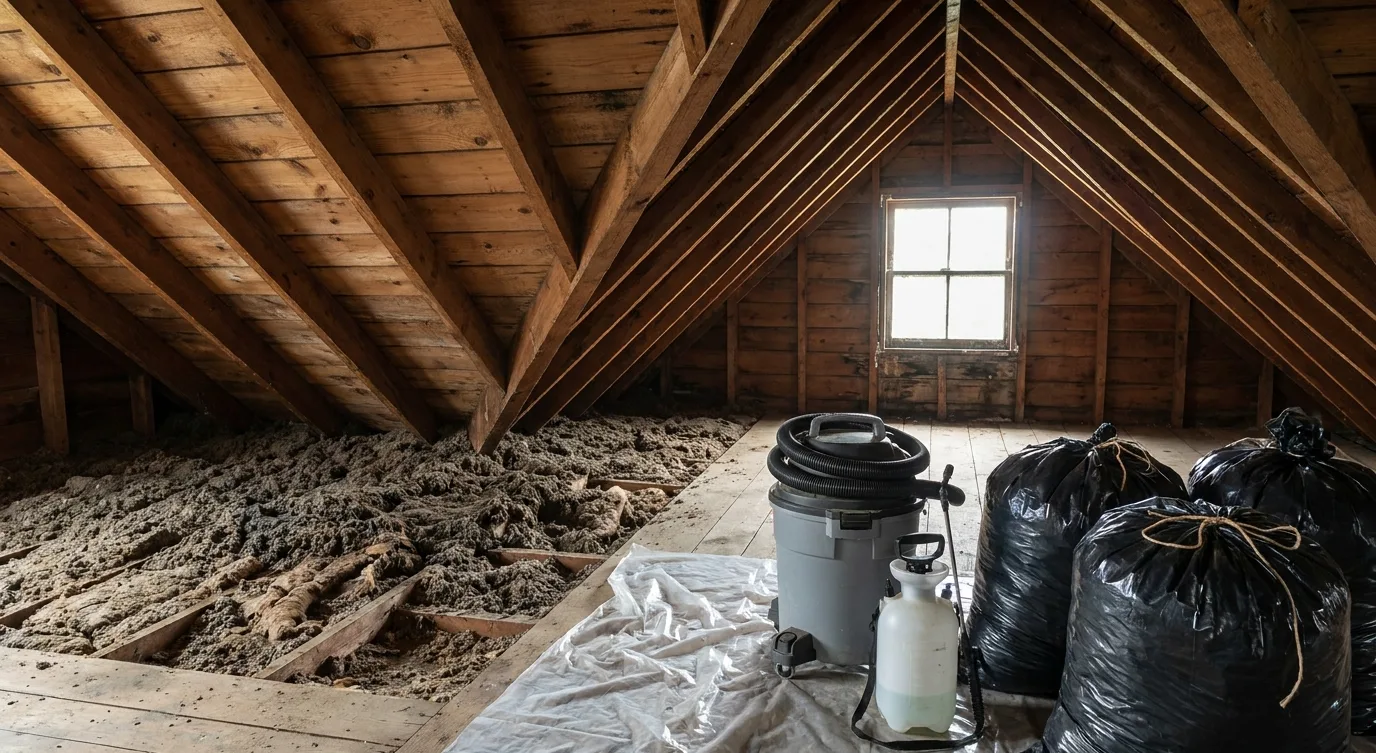
What a rodent-damaged attic looks like
Tunnels through the insulation, flattened trails along the top plates, droppings scattered thickest near the eaves, and wads of paper or fabric where they nested. Blown cellulose, common in a lot of Grand Rapids attics, soaks up urine and holds the smell. Fiberglass batts get matted down and stop insulating well.
Rats are rarer in attics here than mice, but when they do get up there, usually along a tree limb or a downspout, the mess is heavier and the gnawing on wiring and framing is worse. Either way, the attic floor is where most of the evidence ends up.
Heat loss is part of the picture. Insulation that has been tunneled and packed flat is not doing its job, and over a Michigan winter that shows up on the gas bill.
Signs the attic needs more than trapping
- Droppings spread across more than a small patch near the hatch.
- A smell that drifts down into upstairs closets or bedrooms.
- Visible trails or tunnels running through the insulation.
- Yellow-brown staining on the drywall ceiling below, or on the attic side of the boards.
- Nests tucked into the eaves, behind the knee walls or around recessed light housings.
- Chewed wiring insulation or gnawed wood on rafters and joists.
- Insulation that has sunk well below the tops of the joists in places where it used to cover them.
If you only see a few droppings in one corner, trapping, sealing and a careful wipe-down may be all it takes. The list above usually means the attic needs a proper cleanup.
Old vermiculite: we stop, you test
Some older houses have vermiculite insulation, a loose, pebbly fill that is gray-brown or gold and glitters a little in a flashlight beam. Much of the vermiculite sold in past decades came from a mine in Libby, Montana that was contaminated with asbestos. The EPA advises leaving it undisturbed and having it handled by trained asbestos professionals.
If we find vermiculite in your attic, we do not touch it. We stop, show you what we found, and recommend having it tested by an accredited lab before anyone disturbs it. If it needs abatement, that is work for an asbestos contractor, and rodent cleanup can follow once they are done.
Deer mice and the hantavirus question
Most indoor mice in the city are house mice. In garages, sheds and attics near wooded lots, though, deer mice and white-footed mice show up too. Deer mice are the main carrier of the hantavirus strain found in North America. Cases are uncommon, especially in this part of the country, but the CDC recommends the same precautions for any rodent cleanup: air the space out first, never sweep or vacuum dry droppings, and soak everything with disinfectant before removing it.
We follow that approach in every attic, whichever species made the mess, and our crew wears respirators and disposable coveralls while doing it. It is a big reason Grand Rapids Rodent Control treats attic cleanup as its own service, with its own gear and its own visit, rather than something squeezed in at the end of a trapping job.
How the cleanup goes
Rodents out first
We make sure trapping is finished and openings are sealed. Cleaning an attic that mice can still reach is wasted work. Our exclusion and sealing page covers that part.
Protect the house
We lay a covered path from the attic hatch to the door and keep the hatch area contained.
Wet down and disinfect
Droppings, nests and urine-stained spots are soaked with disinfectant and left to sit before anything is lifted, following the CDC's wet-cleaning method.
Remove soiled insulation
Once wetted, badly contaminated insulation is bagged or pulled out with HEPA-filtered equipment built for the job, not a shop vac.
Treat the framing
Joists, top plates and the attic floor get a second disinfectant pass once the insulation is out.
Reinsulate
New insulation goes in at the depth you need, after a last look at the hatch and eave gaps before they get covered.
Heritage Hill and other old-house attics
Big older houses in Heritage Hill often have attics insulated several times over the decades, with different materials stacked in layers, plus balloon-framed walls that open straight into the attic floor. That gives mice a clear route from the basement to the top of the house and makes cleanup slower, because there is more to sort through. It is also where we most often find old vermiculite hiding under newer cellulose. Bigger houses in Ottawa Hills built in the 1920s can be similar, with large attics and several generations of insulation laid on top of each other.
Bungalows and story-and-a-half houses bring a different challenge: tight knee walls and sloped ceilings where only one person fits at a time. Those jobs are slower per square foot, and we plan for it.
Choosing replacement insulation
Once the old material is out, you have a clean slate. Most people go back with blown cellulose or blown fiberglass, since both fill around wiring and framing well in an old attic. We talk through the depth you want and how it works with your existing ventilation, then make sure the baffles at the eaves stay open so air can still move.
Before new insulation goes in, this is also the moment to air seal the attic floor: the gaps around plumbing stacks, wiring holes and the top plates of those balloon-framed walls. Closing those cuts off the inside route mice use from the basement, and it keeps warm air in the house where it belongs. It is worth pairing with a rodent inspection if the rest of the house has not been checked.
Attic cleanup questions
Can I clean the attic myself?
For a few droppings, yes, using gloves and the wet-cleaning method the CDC describes. For widespread contamination, tunneled insulation or anything that might be vermiculite, call someone set up for it.
Do I have to replace all my insulation?
Not always. If damage is limited to a few areas near the eaves, we remove and replace just those sections. If mice had the run of the whole attic, full replacement makes more sense.
Will the smell go away?
Taking out the soiled material and treating the wood handles most odor. Urine soaked deep into old boards can linger, and we can apply an odor sealer to those spots.
Is cleanup done during trapping or after?
After. We finish trapping and sealing first so a clean attic stays clean.
What if there is a dead mouse in the attic?
We remove it as part of the cleanup, along with any nesting around it, and disinfect the spot the same wet way as the rest. If the smell is coming from inside a wall rather than the attic, we track that down separately.